Posts

Showing posts with the label science fiction

Hyperion, by Dan Simmons

Image
You'll find Hyperion by Dan Simmons on most YouTube Top Ten lists of the Greatest Ever science fiction books. I must admit that this was the main reason for my buying this book. I agree, it's not the best of reasons; the internet is full of lists, in fact it's the medium's predominant writing form (allow me some slight exaggeration). However, amongst all the various YouTube science fiction channels there are a decent number of intelligent critics and commentators, and these persuaded me to investigate. I suppose I'm hinting at a little reluctance. This is because I was aware of the basics of the book's structure, from previously reading synopses; and because I did myself study English Literature at university. If the title, Hyperion , means anything to a reader, it might be from Greek Myth or astronomy; but for myself it straight away alluded to Hyperion , an unfinished epic poem by John Keats , the English Romantic poet (capital 'R' there, because th...

2024 > 2025: Some culture from the past year

Image
I want to say that cinema's going to pot, but maybe it's just me that's jaded. I only went to an actual film theatre once, and that was to see the latest Alien film, much of which was a retread of the first Alien film I saw um over forty years ago I believe. It wasn't a total waste of time; at least it sidestepped the pointlessly distracting mythos of mankind's foundation which was introduced in Prometheus and Covenant .  I used to rely on Simon Mayo and Mark Kermode's film reviews on Radio 5 for new films to investigate, but since they decamped elsewhere I've been left with Empire magazine for reviews which I don't trust so much. The basic point is about just knowing what new films are out. But these days they merge films tv series and even games into their star reviews section. So book reading continues to dominate my cultural mindscape. There were three books which made an impact on me this year. The first was  Use of Weapons by Iain M. Banks ...

Provenance, by Ann Leckie, and my reading habit

Image
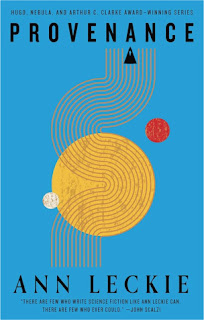
Provenance is a standalone novel which appeared a little while after Ann Leckie had made a considerable impact in science fiction with what came to be known as the Imperial Radch trilogy . No, I don't know how to pronounce that. Perhaps a bit of Googling might turn up a fan's report of how Leckie pronounced it herself at a book signing. But it's not a bad bit of nomenclature. If it's meant to sound a bit like 'Reich', that suits the story well enough. Provenance is set in the same universe, but outside the Radch realm, and a Radch character only appears briefly. I'll say right out, that Provenance is a weaker book than any of those in the Trilogy; it's slighter, smaller in scale, and even seems somewhat uncertain in its intentions at times. But I'm glad I read it , because I'll be one of the many readers who found the setting intriguing and wanted to see more of it. Also, I wanted to read it before I read  Translation State , set in this univ...

Use of Weapons, by Iain M. Banks

Image
I'm stunned by Use of Weapons  by Iain M. Banks . Looking around, this is not an uncommon reaction for readers, to a shock of an ending. I'll say straight off, if there's any chance you'll read the book - if you read SF, if you've heard of it - minimise any time you spend reading reviews. Too bad, that I've already mentioned a shock ending, but... I gather Banks's first try with this story, written I think before his first success with more mainstream fiction, employed a very complicated narrative structure. This later take only appeared as the 3rd in his ' Culture ' series. It still does make demands on the reader, with two interleaved strands, one going forwards recounting the story of mercenary Cheradenine Zakalwe's latest mission for the Culture, the other going backwards to the darkest events of his past. And before even starting you'll notice in the contents the oddity of a book which tails off with an epilogue, some verse, and then a ...

Revenger, by Alastair Reynolds

Image
Space pirates!! Revenger is what you might call a ripping yarn. Two kids steal aboard a pirate's sailing ship and go in search of treasure, hoping to repair the family fortunes. They have to prove themselves to their shipmates, deal with abrasive friendships, betrayals, tragic losses, and all sorts of nasty surprises; all in all growing up very quickly. A great range of unearthly threats and devilish traps confront them, not to mention some very unpleasant villains. Yes, Revenger might well have been a typical classic boy's adventure story; except that this isn't the 19th Century, it's set in space, the 'ship' sails on the sun's light, and the two sibling teenagers are girls. It's the first book in a trilogy by Alastair Reynolds . He's best known for his Revelation Space series, the epitome of what most would think of as 'hard sf'. Which means that the real meat of the books is the speculative science, and its far future setting. I have re...

Consider Phlebas, by Iain M. Banks

Image
Consider Phlebas is the first book in Iain M. Banks's Culture series. It's a fairly loose series; the stories are apparently self contained. 'Apparently'? That, because it's the first Culture book I've read. However, I have read one other of his science fiction books, The Algebraist , also a work of space opera. In some ways it could almost be a Culture book except it wouldn't quite fit. It impressed me as regards his writing and world creation, and since I had another Iain M. Banks Culture book lying around which I'd never read, Look to Windward , I went for that and then saw that it stands quite late on in the collection. I decided to read the first - this one, Consider Phlebas - even if not strictly necessary, figuring that any writer creating an ambitious 'universe' will do a lot of introducing of the features of that universe in the first volume, even if the story itself is fully resolved by the end. A side note here is that I've neve...

Into the Fire, by Elizabeth Moon

Image
As the cover tells you, Into the Fire is the second book in a series titled Vatta's Peace , which follows a five book series, Vatta's War . 'Vatta' is a family and an interplanetary corporation, but it is also the protagonist, Ky Vatta . Its genre is 'military science fiction'. Elizabeth Moon  is new to me, which may be a sign that I really have been out of it as far as science fiction is concerned, because she's been successful, with several series of novels published. I haven't read the earlier Vatta books, but I've picked up most of what I needed to know from the many flashbacks and references to past events. I bought this book having enjoyed the previous volume in the Vatta's Peace series, Cold Welcome , and I picked up that book on the spur of the moment wandering around a bookshop, and being intrigued by the premise. Cold Welcome is a story of a desperate struggle to survive in an icy and very hostile environment after a space shuttle...

A Quiet Place

Image
A Quiet Place is a science fiction / horror film which may have got your attention thanks to its USP of a monster which zeroes in on sound. In the poster pic right, star Emily Blunt is trying to keep silent while there's a monster in the house - and she's about to give birth. I don't want this blog to end up a movie review site, and hence don't intend to post about every film I see; I wouldn't have commented on this film, except that the premise has led to attendance at a cinema showing being an interesting experience . The film is very quiet for long stretches. Music and sound are used to heighten tension; but the main characters use sign language a lot of the time for obvious reasons, and for the most part we're listening to ambient sounds, suffering the tension of knowing that since this is a horror film, a sound is going to disrupt the silence at any moment and death is going to come running. So, by all reports I've heard, audiences have tended ...

Blade Runner 2049's Finnish (Aug 2019 update)

Image
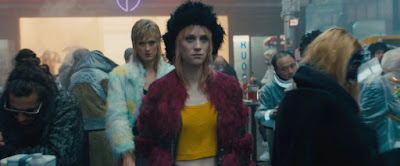
No, that isn't a spelling mistake. This really is about the Finnish in Blade Runner 2049 . There are a few spoilers in this, nothing big, but you may want to check out now. (NB - 2019 follow up comments in PS down at the bottom) I went to see the film a second time, primarily to immerse myself again in that world. Despite the intensely pessimistic vision it offers, its design and cinematography are wondrous and absorbing and I wanted it all again, while I could still get it on the big screen. And it was a big screen, a bigger and better one in Manchester. I went with a friend, which enabled some lively discussion afterwards. I'm glad to say she liked it too, and made several good points. The main one was about the 'glaring plot hole' towards the end (ie. how does so-and-so know how to find *cough* in order to effect a rescue): something's been cut out there, maybe only a bit of script, but something which might have explained it. There were other reasons t...

Blade Runner 2049

Image
I decided to hurry up and see Blade Runner 2049 , once I saw how many pieces are appearing explaining more and more of the plot. Not that anyone's forcing me to read or view those reviews or videos, but just by existing they somehow mess up my anticipation . Am I hypocritically doing the same thing? Well, I'm going to try not to spoil the story. But perhaps what I write here is one of the most redundant offerings to the websphere imaginable; the internet does seem to be flooded with opinions about the film. Which at the very least underlines the place this story has in the culture. Never mind, very few will read this, possibly only the person who prompted me to get my skates on and see it. Just so you know, I saw the original Blade Runner in the cinema at the time of its release. Along with anyone else I knew, I immediately regarded it as the serious science fiction film I'd always wanted; and irrespective of genre, a monumental piece of cinema. I have the five-versio...

The Citadel of the Autarch, by Gene Wolfe

Image
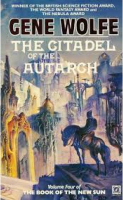
I've just read this, and it's a case of 'at long last' to put it mildly. It's the 4th and final volume of Gene Wolfe's The Book of the New Sun , which started appearing in the Eighties and it was then that I read the first two volumes. I bought them as they came out in paperback, and they've yellowed over the years, waiting on various bookshelves in the course of several house moves, until last year when I picked up the 3rd volume, The Sword of the Lictor , found I still had a taste for it, and so duly finished the series with this. I fully accept this is a ridiculous way to go about reading, especially in this case, when the four volumes are very much four consecutive parts of one long book. I gather that it could very easily have been published as one volume. But it seems I've been inclined to complete things in recent times. Perhaps it's just my OCD instincts. Now I'll reveal that I've written down every book I've ever read, in a l...